



Another step forward towards conservation efforts is our collaboration with Murdoch University in investigating whether photos posted to social media of Borneo Pygmy Elephants could help with their management and conservation. Obelia Walker, Honour student from the School of Veterinary and Life Sciences who joined us in August, has been piloting the cutting edge project in Borneo, Malaysia.
Read: Saving rare elephants with tourism snaps.
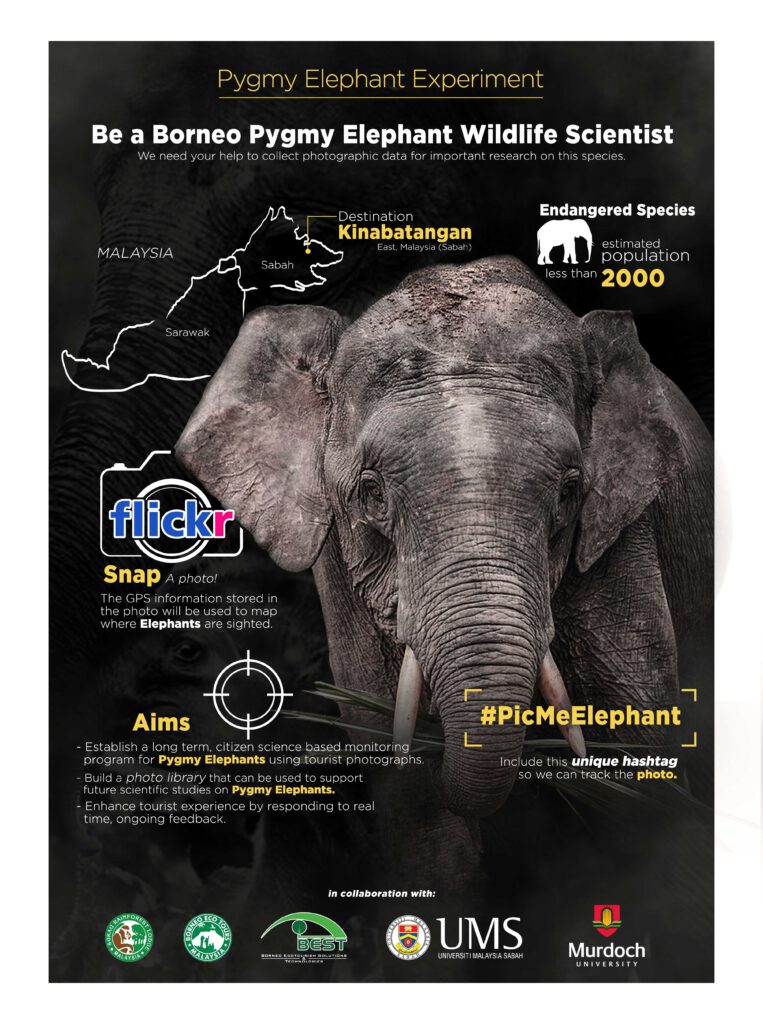 The project is currently being carried out at Sukau, the Lower Kinabatangan area. Obelia has been working closely with our tour guides and guests visiting the Lower Kinabatangan River where the elephants can be found, and asking them to post their pictures from sightings to Flickr and other social media platforms with the hashtag #PicMeElephant.
Borneo Pygmy Elephants are one of the least researched elephant sub-species in the world, and these small elephants are endangered, with an estimated population of less than 2,000 left in Sabah, Borneo- Which brings us to the real need of collecting data about these vulnerable creatures.
The #PicMeElephant project uses a simple technique of taking photos and geotagging them, and the steps taken are just as easy. At the lodge, guests will first be briefed by Obelia or an appointed lodge representative about the project. To get involved, they just need to follow these super simple steps:
1. Activate location service on smartphone camera
2. Photograph the rare Borneo Pygmy Elephants
3. Sign up to Flikr and change settings to public
4. Upload photo with the hashtag #PicMeElephant
“By utilising tourist and tour guide pictures, we have demonstrated a non-invasive and cost effective technique for tracking movements over a given period” explained Obelia.
“The feedback I’ve had from the tourists and local naturalists so far has been extremely positive. Guests have been very enthusiastic about contributing to the project by uploading their pics, usually when they return home from their travels in Sabah.”
The first half of the year, only 12 geotagged photos of Borneo Pygmy Elephants were shared on social media. The numbers have grown to over 170 geotagged photos after guides and tourists began sharing their findings since the #PicMeElephant project launched in August, and these numbers are believed to grow with time.
“Given the nature of the collaboration in this project, there would be future opportunities for students from both Murdoch University and Universiti Malaysia Sabah to adapt this approach in their own research pursuits,” Obelia commented.
Besides that, the latest initiative by Borneo Eco Tours (BET) and BEST Society is the Borneo Land Conservancy (BLC) project that aims to conserve land for wildlife habitat in Sukau, along the floodplains of Kinabatangan. It was after much research and constant communication with our networks in 2016 that BET and (BEST) Society were able to identify a piece of land for such an initiative. The land size is 7.7 acres and is located in Sukau, just five minutes upriver from Sukau Rainforest Lodge. The land was up for sale at RM280,000.00 (later lowered to RM220k) which BET and BEST Society decided to buy solely for the purpose of conservation and later, research and education. Funds are currently being raised through BEST Society to secure the land and in due time, a research centre will be built there to accommodate researches and students alike.
Early this year, the wildlife of Sukau came face to face with a forthcoming danger against their well-being and habitat when a new development project in the area came into attention and was already on the way. It was a sudden matter that came without warning, much to the public’s surprise. Many protested until finally (and thankfully), the project was put to a stop. If it wasn’t for the clamor that environmentalists, conservationists, ecotourism players and the concerned public had made about the Sukau Bridge development project, the news would probably have never reached Sir David Attenborough whose comment and open letter to the Sabah state Chief Minister had helped to put a halt to its progression.
“I have had many encounters with the magnificent and unique species with which your state is blessed. If this construction is allowed to go ahead, I am left in no doubt that the bridge will have significant negative effects on the region’s wildlife, the Kinabatangan’s thriving tourism industry and on the image of Sabah as a whole,” the Guardian quoted Attenborough saying in a letter.
So that’s one monster we managed to take down. There’s so many more others out there that threaten not only Sabah’s natural and wildlife treasures, but also Borneo and the whole world. News about elephants found dead and mutilated in Sabah have become more frequent in the media and to date, six elephant deaths have been reported this year. Some of these elephants’ deaths were confirmed to be works of ivory poachers while others were suspected to be locals who are trying to protect their farms and palm oil plantations. Presently, elephants are considered to be a threat and nuisance to the locals, estates and plantation developers. The elephants are said to cause millions of loss towards the palm oil plantation industry in the state, which raises the human-animal conflict issue further.
Our NGO division, Borneo Ecotourism Solutions & Technologies (BEST) Society are currently in the works of developing a solution to reduce the impact of human-elephant conflict through bee farming. The beehives will act as a natural barrier that repels elephants from encroaching crops within its vicinity. Though further research and time is needed to perfect the project and make it a success, we believe that the bee farming project is the ideal solution to the human-elephant conflict issue.
Our wildlife treasures and their homes are constantly being threatened left and right, and there’s only so much a few can do. But together as responsible individual, a community, we at Borneo Eco Tours believe that so much can be done to put a stop to such destruction.
NewsSustainable TourismTravels Another Step Forward Towards Conservation in Lower Kinabatangan
By Borneo Eco Tours
5 November 2017